Curtains Measured for the Window You Use
Work out where the fabric will sit when the curtains are open, what it must do when closed, and how far a hand can comfortably reach.
The outline of a window tells you surprisingly little about the curtains it needs. A sash may slide within its frame, while the glass door beside it swings inward through the space where cloth would naturally hang. A window with a deep sill might hold the plant you water every Sunday. Another brings in most of the daylight for a room and loses a noticeable amount of it when a curtain covers just the outside edge of the glass. Measuring the opening is one job. Measuring the way you use it takes a little longer.
Begin with the curtains open and closed in your mind. Decide whether they will close daily, stop a specific patch of glare, soften a view, or mostly stay open. Write down the two or three things that would be inconvenient if you put the cloth in the wrong place. You may need to open the window in rain, see out while working at a desk, or hide a bright stair light across the street at night. A solution for one of those concerns can make another worse if you treat the whole wall as a blank surface.
Find somewhere for the fabric to go
When curtains are open, the folded fabric still occupies space. Draw the outline of the window on a scrap of paper and shade in the area at each end where a panel could collect. Now compare your drawing with the wall. A wardrobe may occupy one end. A corner can prevent a rail from extending very far, while a tall cabinet may leave enough space for a bracket but none for a hand to operate the curtains.
You can estimate the practical width of a gathered panel with a sheet. Fold it to something close to the panel width you are considering, loosely bunch it, and ask someone to hold it beside the window while you stand back. The result will be approximate. Thicker lining, closely spaced pleats, large rings, and stiff fabrics all affect how the panel gathers. Ask for the stacked width when buying made to measure curtains, especially if the curtain must clear a door or you have very little extra wall.
Where there is space on both sides, the curtains can frame the opening without covering much glass. Where space is uneven, a single panel drawn to the wider side may do the job. Make sure you can still reach its leading edge when it is fully open. A window treatment that technically clears the doorway can still be awkward if you have to step behind the sofa to close it.
Test the floor and ceiling with a tape measure
Determine the height of the actual point where the fabric will hang. A ring with a clip, a hooked pleat, and a curtain with holes around the pole put the top of the fabric in different places. Measure from that hanging point to the intended hem. Put the number on the sketch with a note about where you started. Suppliers often describe their own measuring conventions. Compare your sketch with their diagram before ordering, since a listed length may refer to the finished panel or to the distance from a specific part of the rail.
Take the same measurement on both sides of the window and in the middle. An old floor can slope enough that a hem clears the floor at one end and brushes it at the other. Decide what you want it to do in use. A hem that hangs a little above the floor is easy to draw and leaves space for a vacuum. A hem that breaks onto the floor looks soft but will gather dust and can shift when someone walks through a door. Where the floor is uneven, you can adjust individual hooks if the hardware permits or have the hem marked while the curtains are hanging.
Short curtains are practical above a deep shelf, a desk, or some other fixed obstruction. If the curtains stop at a sill, test whether the sill actually reaches beyond the fabric. A sill that projects only a little may fall behind the curtain when the panel hangs from a rail set well out from the wall. Keep curtains well clear of heaters and follow the appliance manufacturer's clearance instructions. Measure while the window handle is open too. Handles that seem flush with the wall in their resting position can press into the cloth when turned.
Decide whether you need privacy in daylight or darkness
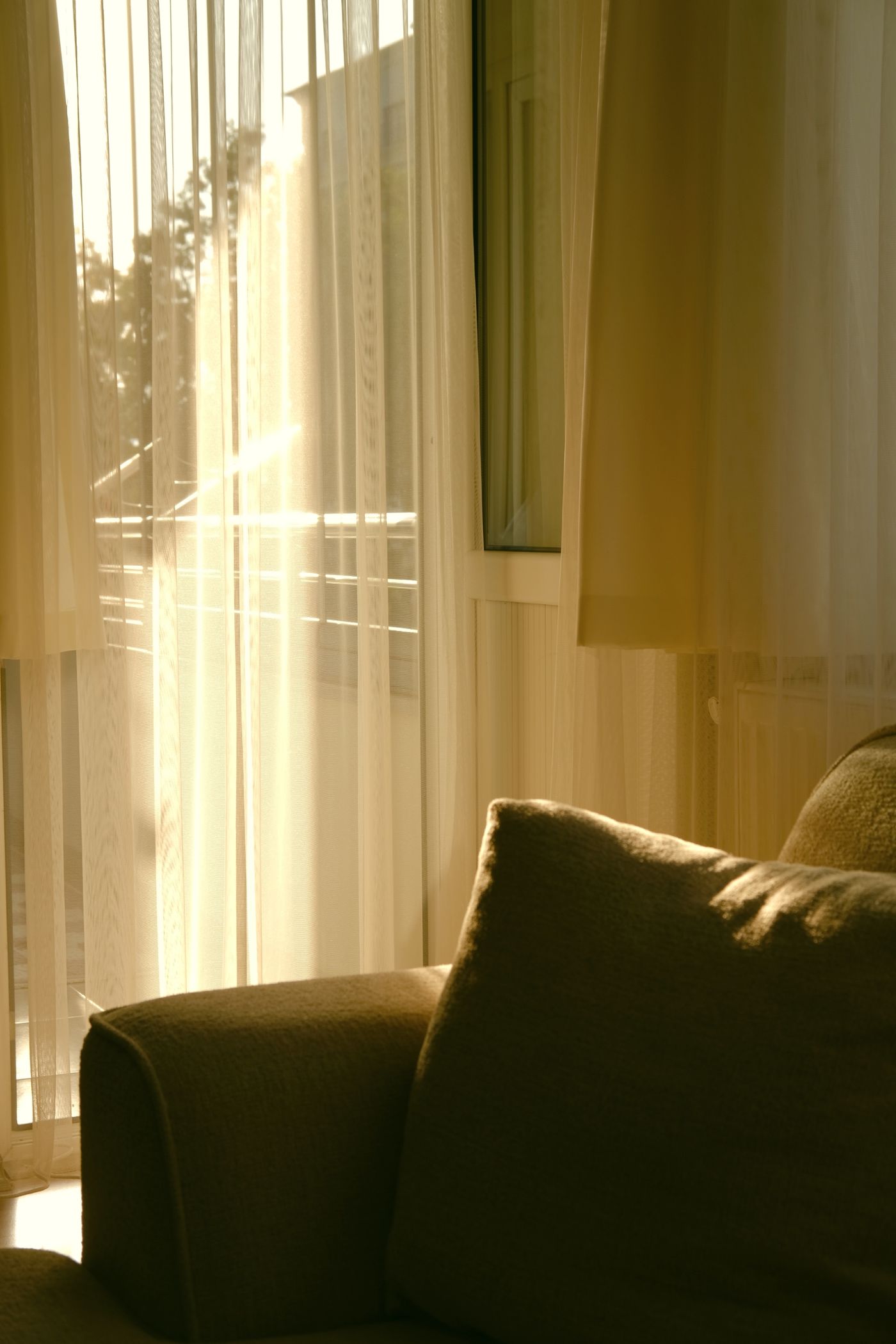
A sheer curtain changes what people can see when there is more light on one side than the other. In daylight, a room may look concealed from the bright street. At night, with a lamp lit indoors, the same cloth can reveal silhouettes or a surprising amount of detail. Try a large sample over the window and check from outside where you can do so safely. If someone is helping, ask them to stand in the usual spot inside the room with the lamps as they would be on a normal evening.
Privacy and darkness are different jobs. A lined curtain may conceal everything from view and still let light trace the top, the sides, and the join in the middle. Think of the incoming light as a set of paths. If a streetlight shines diagonally across the room, the gap nearest its side of the window matters more than the fabric's performance in the middle. Where room darkening is the goal, look at how the proposed fitting handles gaps before choosing a heavier cloth.
A blind inside the opening paired with simple curtains can be useful where you want quick adjustments throughout the day. The blind can deal with a rectangle of sunlight while the curtains stay open, and either layer may handle evening privacy depending on its construction. Choose window coverings with operation appropriate for the household, particularly where children live or visit. A practical daily arrangement should feel manageable from the floor with furniture in its normal position. Walk through the sequence you expect to follow in the morning and again at night.
Compare cloth in the room where it will hang
Large surfaces pick up color from walls, trees, and reflected light. Put a fabric sample near the window, then move it to the wall where the panel will gather. Look once around midday and once with your evening lights on. A cloth may look white in front of the glass and distinctly pink beside a clay colored wall. A color that pleases you as a small cutting could dominate when several yards are gathered at one end of the room. A larger swatch or a returnable panel is especially useful if the cloth has a strong pattern.
Hold the fabric in folds. A pattern across a flat swatch will be seen in fragments when gathered. Small checks can read as texture at a distance, while a broad stripe may change direction around a deep pleat and look quite different along the hem. If you want a large motif to be visible when closed, ask how the fabric will be matched across panels. Pattern repeats can also affect how much cloth a maker needs. Measure width as well as length and use the maker's instructions on fullness. A finished pair can be wider than the rail and still look strained when shut if the header and folds use up most of the extra cloth.
Check care information with the same attention you give color. If the window sits near a frequently opened door or a kitchen, a washable unlined fabric can suit the spot because you expect to clean it often. If a curtain has a lining or unusual surface, its approved cleaning method may be different from that of a similar plain fabric. Consider the weight of the panel while handling it. A long heavy curtain takes more work to remove and rehang than a light pair on a rail at a reachable height.
Try the hardware in the places that matter
Use the mounting instructions to mark proposed bracket and track positions on a drawing. Check the wall or ceiling construction and use suitable fixings. A fabric sample can feel modest in your hand, while two full lined panels and a long pole ask much more of their supports. Consult an installer if you are unsure about the wall or the required supports, or if you rent and the proposed fitting needs permission. Brackets can also interrupt the movement of rings, so confirm where each panel will stop on its way across the window.
Before ordering, mark the outer ends and the proposed hem with removable tape on surfaces that can take it. Look at the marks from the desk, the bed, and the doorway. Open the window and simulate pulling the curtains shut. A rail shown well above the window in a photograph might look elegant on your wall, but the operating point still has to be reachable. If you intend to pull a panel by its edge, think about whether the hem will travel freely as you do it.
Once the curtains are up, use them for several days before changing the hem or deciding you need a tieback. Fabric can relax after it hangs. Ordinary daylight will reveal whether the gathered cloth occupies more of the window than expected. An evening with a visitor may uncover glare from a single gap that stayed invisible while you were measuring. Adjust what you can at the fittings first. Good curtains end up following a routine so natural that you stop noticing how much measuring went into them.